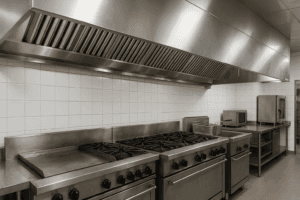
Picture the scene. It’s Friday night in downtown Salt Lake City. The tickets are printing faster than you can pull them, the line is slammed, and the heat in the kitchen is absolutely sweltering. You’ve got steaks searing, fryers bubbling, and chaos everywhere. In that moment, the last thing on your mind is the metal box hanging over your head. But honestly? It’s probably the most critical piece of equipment in the building. We’re talking about your Kitchen Exhaust system. Most folks just call it the “hood,” but it’s really the lungs of your restaurant. When it’s breathing right, everyone is happy. When it’s choked up with Grease, you are sitting on a ticking time bomb.
Here’s the thing about Commercial kitchens: they are messy, greasy beasts. It doesn’t matter if you run a high-end bistro in Park City or a burger joint in Sugar House; grease is the great equalizer. It gets everywhere. And while your staff scrubs the countertops and mops the floors every night, that Exhaust system is slowly, silently collecting fuel. That’s essentially what grease is—fuel. Ignoring it isn’t just about hygiene; it’s about survival.
The Invisible Danger: Why Grease is So Scary
You might look up at your hood filters and think, “Eh, they look a little shiny, but it’s fine.” But let me explain what’s happening where you can’t see. The filters are just the gatekeepers. Behind them lies the plenum, the ductwork, and eventually the upblast fan on the roof.
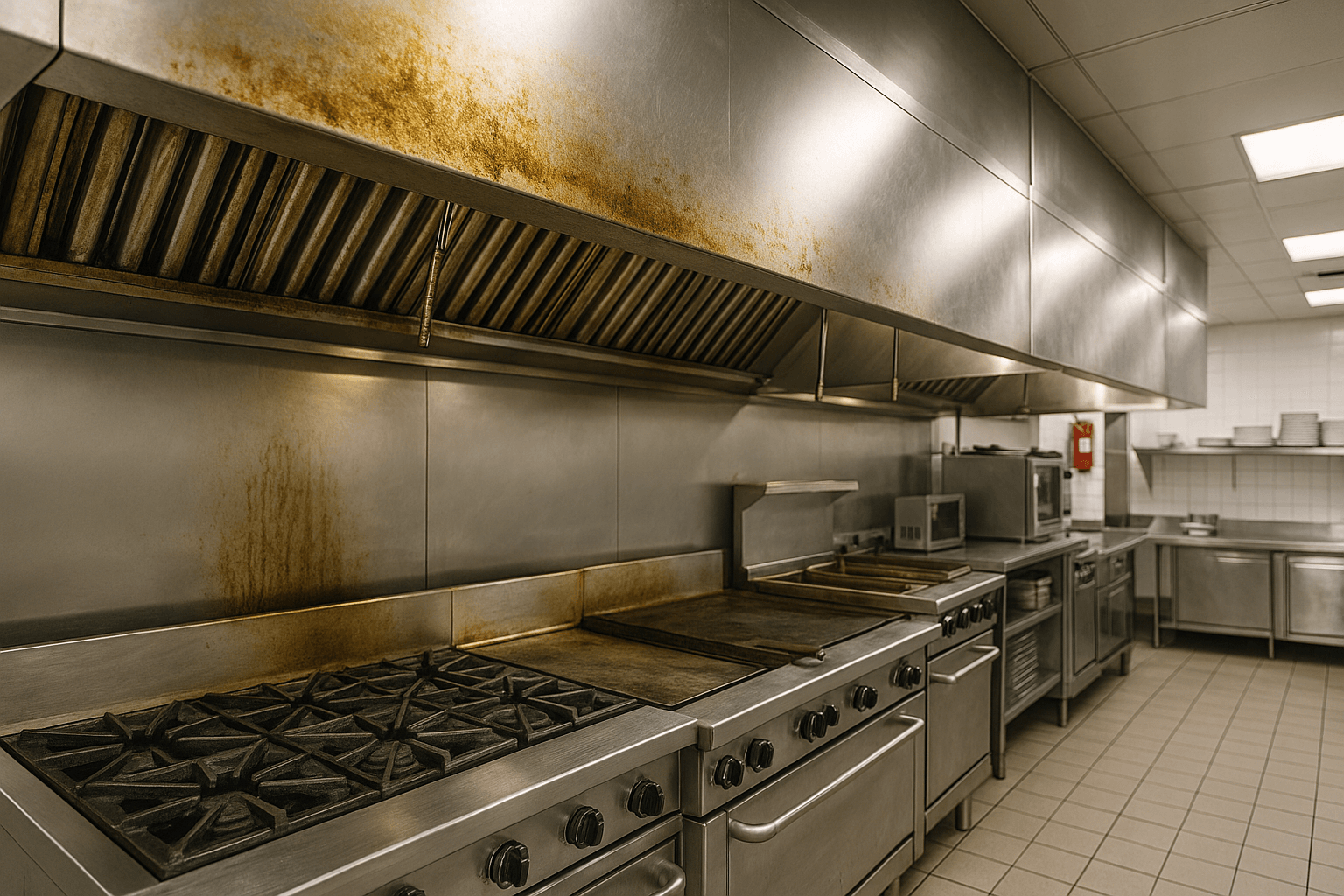
When cooking vapors rise, they carry vaporized grease. As that vapor travels through the system and cools down, it condenses back into a liquid or a sticky solid. It coats the inside of your ducts like cholesterol in an artery.
Now, imagine a flare-up on the grill. A chef tosses a ribeye on, and the flames jump a foot high. If your filters and ducts are clean, the system sucks that heat and smoke up and out. No problem. But if that system is coated in old, hardened grease? That flame isn’t just heat anymore; it’s a match.
Fire moves fast. In a grease-laden duct, fire moves frighteningly fast. It can shoot up the ductwork and reach the roof in seconds. We’ve seen photos of restaurants where the kitchen looks okay, but the roof has collapsed because the fire burned so hot inside the ventilation shaft. It’s a nightmare scenario, and it happens more often than you’d think.
NFPA 96 standards exist for a reason. This isn’t just bureaucratic red tape; it’s the National Fire Protection Association telling us exactly how to keep buildings from burning down. Keeping that system down to “bare metal” is the only way to ensure that a small flare-up doesn’t turn into a catastrophic loss.
It’s Not Just About Fire: Airflow and Efficiency
Let’s step away from the scary fire talk for a second. Let’s talk about comfort. You know how hard it is to keep good kitchen staff these days? It’s a struggle. The labor market in Utah is tight. If your kitchen is filled with smoke and feels like a sauna, your turnover rate is going to skyrocket.
Your Exhaust fan is designed to pull a specific amount of cubic feet per minute (CFM) of air. It removes heat, smoke, and odors. But here is the kicker: as grease builds up on the fan blades, it throws the fan off balance. It gets heavy. The motor has to work twice as hard to spin that heavy fan.
Eventually, the fan slows down. It can’t pull the air it used to. Suddenly, your kitchen is hazy. The AC can’t keep up because the heat isn’t escaping. Your chefs are miserable, sweating through their coats, and breathing in particulate matter that should be floating over the Salt Lake Valley, not lingering by the salad station.
A clean system is an efficient system. When we scrape and pressure wash those blades, we aren’t just cleaning; we are restoring the aerodynamics of your ventilation. You might actually notice your utility bills drop slightly because your HVAC system isn’t fighting a losing battle against a hot kitchen.
The Roof: Out of Sight, Out of Mind
Can we be honest? When was the last time you climbed a ladder and looked at your restaurant’s roof? If you are like most owners, the answer is “never” or “when the roof leaked.”
This is where the nastiest surprises hide.
When an exhaust fan is saturated with grease, it starts to leak. That grease oozes out of the fan housing and spills onto the roof surface. We call it “roof soup.” It’s gross, sure, but it’s also destructive. Grease is acidic. It eats through rubber roof membranes.
We have seen situations where a restaurant owner had to replace an entire section of their roof because the grease ate a hole right through it. Water started coming in, ruining the ceiling tiles in the kitchen. It’s a mess that costs thousands of dollars to fix.
This is why grease Containment systems are so important. We install hinge kits and catch pans to make sure that grease stays where it belongs—captured and disposed of—rather than turning your roof into a slip-and-slide. Plus, if a health inspector or a landlord goes up there and sees a grease slick? You are going to have a very bad day.
The Boring (But Essential) Stuff: Insurance and Inspections
Okay, let’s talk paperwork. I know, it’s not exciting, but it’s part of the game.
Insurance companies love to deny claims. It’s practically their business model. If you have a kitchen fire—even a small one—the first thing the adjuster will ask for is your hood cleaning records. They want to see the certificate. They want to know if you were compliant with NFPA 96.
If you can’t prove that a certified professional cleaned your system recently, they can deny your claim. They will say the fire was due to “negligence.” Imagine losing your business and getting zero payout because you skipped a cleaning to save a few hundred bucks. It’s just not worth the risk.
And then there are the local authorities. The Salt Lake County Health Department and the local fire marshals aren’t trying to be mean; they just want everyone to be safe. They know exactly what to look for. They have flashlights, and they aren’t afraid to look up the chute.
If they see carbonized grease dripping from the hood, they can shut you down on the spot. “Closed by Order of the Health Department” is a sign that kills your reputation faster than a bad Yelp review. Keeping a regular schedule with a professional cleaning service keeps the inspectors happy. And when they are happy, you can focus on cooking food, which is what you actually want to do.
How Often Should You Actually Clean It?
This is the most common question we get: “Do I really need to do this every three months?”
The answer? It depends.
There is no one-size-fits-all schedule. It entirely depends on what you cook and how much of it you cook. A vegan café that mostly steams vegetables is going to generate a lot less grease than a steakhouse charbroiling ribeyes 12 hours a day.
Here is a general breakdown of how the industry—and the fire codes—usually view frequency:
| Type of Cooking Operation | Recommended Frequency | Why? |
|---|---|---|
| Solid Fuel Cooking (Wood burning ovens, charcoal) | Monthly | Creosote buildup is extremely flammable and dangerous. |
| High-Volume Fast Food / 24-Hour (Burgers, fryers) | Quarterly (Every 3 Months) | Heavy grease volume accumulates rapidly. |
| Average Sit-Down Restaurant (Dinner service, mixed menu) | Semi-Annually (Every 6 Months) | Moderate buildup; standard compliance schedule. |
| Low-Volume / Seasonal (Camps, churches, daycares) | Annually | Very low grease production. |
You know what? Most restaurants in Salt Lake City fall into that quarterly or semi-annual bucket. But don’t guess. Ask a professional to inspect it. We can measure the grease depth (literally, with a comb-like tool) and tell you exactly what your accumulation rate looks like.
The Difference Between “Cleaning” and “Restoring”
There is a misconception that hood cleaning is just wiping down the stainless steel so it looks shiny for the chef. That’s the easy part. That’s the “cosmetic” clean.
A real Utah Hood Cleaning service goes way deeper. We are talking about pressure washing. We use hot water—really hot—and specialized chemicals that break down the molecular bond of the grease.
We have to wrap everything in plastic. Your fryers, your prep tables, your floors—it all gets covered. Why? Because when we start blasting the ductwork, black sludge comes pouring out. It’s a dirty job. It’s messy. If a cleaner comes in, spends an hour, and leaves without breaking a sweat, they didn’t clean your ducts. They just polished your hood.
You need a company that cleans to “bare metal.” That means if you run your finger along the inside of the duct (please don’t actually do this while it’s hot), there shouldn’t be any sticky residue. It should feel like metal.
This also includes the access panels. Sometimes, the ductwork twists and turns through the ceiling. You can’t clean around a 90-degree bend from the bottom. You have to open the duct up. If your cleaner isn’t checking for access panels, they are leaving massive sections of your system uncleaned. That’s where the fire starts.
Why “Chuck in a Truck” is a Bad Idea
I get it. Margins in the restaurant business are razor-thin. When you see an ad on KSL Classifieds for a guy offering to clean your hood for $150, it’s tempting. He’s got a power washer in the back of his pickup, and he says he knows what he’s doing.
Don’t do it. Just don’t.
Professional hood cleaning is technical work. It involves liability. If “Chuck” falls off your ladder, who pays? If “Chuck” forgets to turn the fan back on and your kitchen fills with smoke the next morning, will he answer the phone? If “Chuck” blasts water into your electrical conduit and fries your Ansul system, you are looking at thousands in repairs.
A legitimate company carries liability insurance. They are certified. They take before-and-after photos—not just to show off, but to prove to your insurance carrier and the fire marshal that the job was done right. They provide a sticker on the hood with the date of cleaning and the next service due date.
You are trusting this vendor with the safety of your building. This isn’t the place to cut corners. You want a partner, not just a day laborer with a hose.
The Local Angle: Salt Lake City’s Specific Challenges
You might wonder if being in Utah makes a difference. Surprisingly, it does. Our climate is incredibly dry. We have dust. We have that lovely inversion layer in the winter.
Dust and pollen mix with grease to create a sludge that is harder to remove than just pure grease. It forms a sort of “concrete” in the ducts if left too long. Furthermore, with the elevation changes and temperature swings we get here—100 degrees in July, 10 degrees in January—your roof fan takes a beating. The expansion and contraction of the metal can loosen belts and vibrate screws loose.
A local cleaner knows this. We check the belts on the fan. We listen to the motor. We aren’t HVAC technicians, but we know what a dying fan sounds like, and we can give you a heads-up before it fails on a Saturday night rush.
It’s About Peace of Mind
At the end of the shift, when you lock the doors and turn off the lights, you want to know that your restaurant is safe. You want to know that if a fire did start, the suppression system would work and the fire wouldn’t have a highway of grease to travel on.
Maintaining your kitchen exhaust system is protecting your investment. It’s protecting your employees. It’s protecting your patrons.
It’s easy to ignore the things we can’t see. But in a commercial kitchen, the invisible things are usually the ones that bite the hardest. Don’t wait until you smell smoke or hear a rattle in the fan. Be proactive. Get on a schedule.
Keeping your kitchen exhaust system clean isn’t just a chore; it’s the backbone of a safe, efficient, and successful restaurant. And honestly? Seeing that stainless steel shine after a deep clean is pretty satisfying, too.
If you are looking at your hood right now and realizing it’s been a little too long since the last service, or if you just aren’t sure if your current cleaner is doing a thorough job, let’s talk. We can come out, take a look, and give you an honest assessment of what’s going on up in those ducts.
Don’t let grease put your business at risk. Give Utah Hood Cleaning a call today at 801-853-8155 or go online and Request a Free Quote. Let’s keep your kitchen safe and your doors open.