Let’s be honest for a second—running a Commercial kitchen in Salt Lake City is a juggling act. You’ve got the front-of-house managing hungry customers, the back-of-house trying to keep ticket times down, and somewhere in the middle, you’re trying to keep the lights on and the margins healthy. It’s chaotic, it’s loud, and it’s incredibly fast-paced. Amidst the clatter of pans and the shouting of orders, it’s easy to overlook what’s happening right above your head. I’m talking about the hood system.
You know, that massive stainless steel contraption that hums loudly all day? It’s the lungs of your kitchen. And just like lungs, if they get clogged up, everything else starts to suffer. A lot of folks think of hood cleaning as just another box to check for the fire inspector—a grudging necessity. But if you really look at it, keeping that system clean is probably one of the most critical things you can do for your business.
It’s not just about avoiding a fine. It’s about the fact that Grease is sneaky. It doesn’t just sit on the filters; it vaporizes, travels up the ducts, settles on the fan blades on the roof, and turns into a ticking time bomb. So, let’s walk through why getting regular, professional cleaning isn’t just “good practice”—it’s the lifeline of your restaurant.
1. Preventing the Nightmare Scenario: Fire Hazards
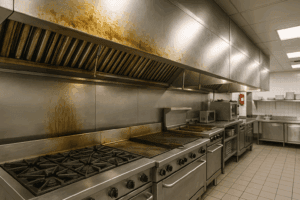
We have to start with the scary one. It’s the elephant in the room. Grease is flammable. Extremely flammable. When you’re cooking high-volume meals—smashing burgers, frying chicken, searing steaks—animal fats and oils vaporize. The hood sucks them up, which is great, but as that vapor cools, it solidifies into a sticky, glue-like sludge that coats everything.
Here’s the thing: that sludge is fuel. If a flare-up happens on the cooktop—maybe a flambé goes wrong or a grease trap overflows—and those flames lick up into the hood, old grease acts like a fuse. Within seconds, a manageable stovetop fire can turn into a structural fire that rips through the ductwork and onto the roof.
According to the National Fire Protection Association (NFPA), a huge chunk of restaurant fires start in the cooking area, and the ones that do the most damage almost always involve the Exhaust system. By keeping to a strict Kitchen Exhaust cleaning schedule, you aren’t just cleaning metal; you are removing the fuel load. You are literally taking the ammunition away from the fire.
You know how dry it gets here in Utah, especially in the summer. We don’t need any extra help starting fires. A bare metal duct won’t burn, but a duct coated in an inch of grease? That burns hot and fast.
2. Keeping the Health Department Happy
Is there anything more stressful than seeing a health inspector walk through the door with a clipboard? Your heart drops a little, right? They have an eye for detail that borders on the supernatural. While they are checking temps in the walk-in and looking for cross-contamination, they are absolutely looking at your ventilation.
If they see grease dripping from the hood cup, or if the baffles look like they haven’t been scrubbed since the 90s, they know immediately what the rest of the sanitation habits are likely to be. It’s a red flag. A dirty hood suggests a dirty kitchen.
Regular professional cleaning keeps you compliant with local Salt Lake City health codes. When an inspector sees a certification sticker on the hood showing a recent cleaning, the tension in the room drops. It shows you care. It shows you aren’t cutting corners. And honestly, avoiding a shutdown or a low letter grade is worth every penny of the service cost.
3. Improving Airflow and Temperature Control
Have you ever walked into a kitchen that felt suffocating? Like the air was heavy, hot, and smelled like old fryer oil? That is usually a symptom of a choked Exhaust system. When the fan blades on the roof get caked with heavy grease, the fan becomes unbalanced. It slows down. It can’t pull air the way it was designed to.
This creates a few problems:
- Heat build-up: If the hot air isn’t leaving, it stays in the kitchen. Your staff is already working over open flames; they don’t need the ambient temperature to be 100 degrees because the fan is wheezing.
- Smoke retention: During a dinner rush, smoke happens. A clean system sucks that smoke out instantly. A dirty system lets it linger, stinging eyes and ruining the vibe.
- Odor migration: If the negative air pressure isn’t maintained, kitchen smells drift into the dining room. Customers want to smell the food when it arrives at the table, not the stale ghost of yesterday’s garlic while they’re waiting in the lobby.
By ensuring the entire system—from the hood plenum to the rooftop fan—is scraped and polished, you restore the aerodynamics of the ventilation. The kitchen stays cooler, the air stays clearer, and everyone breathes a little easier.
4. Extending the Life of Your Equipment
Commercial kitchen equipment is expensive. You know this. A decent rooftop up-blast fan can cost a small fortune to replace. When grease builds up on the fan blades, it doesn’t distribute evenly. This causes the fan to wobble. That vibration might seem minor at first, but over weeks and months, it shakes the motor shaft, wears out the bearings, and eventually burns out the motor entirely.
It’s basic mechanics. A clean fan is a balanced fan. It spins freely with less resistance. By scheduling preventative maintenance and cleaning, you are essentially buying time. You’re making sure that fan lasts for ten years instead of two.
And it’s not just the fan. When grease isn’t captured properly by the hood, it settles on *other* surfaces in the kitchen. It lands on the pilot lights of your ovens, gumming them up. It settles on the gaskets of your refrigeration units, degrading the rubber. It’s a mess. Keeping the extraction system working correctly protects the entire ecosystem of your kitchen hardware.
5. Lowering Utility Bills
This one surprises people. Can cleaning a hood actually save you money on power? Absolutely. Think about your HVAC system at home. When the Filter is dirty, the unit runs longer and works harder to cool the house, right? Same principle here.
When an exhaust fan is fighting against layers of sludge and restricted airflow in the ducts, the motor draws more amperage to maintain speed. It’s working overtime, all the time. That shows up on your electric bill.
Furthermore, if your exhaust isn’t pulling hot air out efficiently, your kitchen’s air conditioning system has to work double-time to compensate for the trapped heat. You end up paying to heat the air with the ovens and then paying again to cool it down with the A/C, all because the exhaust fan is clogged. It’s a waste of energy that hits your bottom line silently every month.
6. Insurance Compliance (The Fine Print)
Here’s a scenario nobody wants: a fire happens. You file a claim. The insurance adjuster comes out, looks at the ductwork, sees inches of neglect, and denies the claim. It happens more often than you’d think.
Most commercial property insurance policies have a clause regarding NFPA 96 compliance. They require you to maintain the cooking equipment and exhaust systems at specific intervals depending on your cooking volume (monthly, quarterly, or semi-annually). If you can’t prove you did that—if you don’t have the certificate from a professional cleaner—you might be left holding the bill for the entire restoration.
Think of professional hood cleaning as an extension of your insurance policy. It’s your proof of due diligence. It protects your liability.
7. Employee Morale and Retention
We touched on the heat earlier, but let’s talk about the people. The labor market in Salt Lake City is tight. Good line cooks and chefs are hard to find and harder to keep. If your kitchen is a hot, smoky, greasy dungeon, people aren’t going to stick around.
Working in a professional kitchen is physically demanding enough without having to fight through a haze of smoke or slip on floors that are greasy because the ventilation isn’t capturing the airborne oil particles. A clean, well-ventilated environment tells your staff that you respect their working conditions.
It sounds small, but comfort matters. A happy crew cooks better food. They show up on time. They don’t walk out in the middle of a shift because they can’t take the heat anymore. Investing in hood cleaning is investing in your team.
8. Why You Can’t Just “DIY” It
I get asked this sometimes: “Can’t my staff just scrub it?”
Well, they can scrub the visible parts. They can run the baffles through the dishwasher (and they should, daily). They can wipe down the stainless steel canopy. But they cannot reach the ductwork that snakes up through the ceiling. They can’t dismantle the rooftop fan to scrape the blades. They don’t have the high-pressure hot water systems or the industrial-grade degreasers needed to strip bare metal without damaging it.
Professional Hood Cleaners have tools that reach the places you can’t see. We have spin jets that go down the vertical ducts. We have Containment systems to make sure the grease we wash off doesn’t ruin your roof membrane (which is a whole other expensive problem if grease eats through your roof).
Asking a line cook to clean the ductwork is dangerous and ineffective. It’s a job for specialists who are certified to handle the chemicals and the heights. Plus, your staff is there to cook, not to be industrial cleaners.
9. Pest Control Benefits
You know what loves grease almost as much as fire does? Cockroaches and rodents. It’s a high-calorie buffet for pests. If you have grease pooling in your ducts or trickling down the side of your building from a leaking rooftop fan, you are ringing the dinner bell for every pest in the neighborhood.
Once they find that food source, they find a way inside. Keeping the ducts and the rooftop unit spotless removes a major attractant. It’s a sanitation barrier that supports your pest control efforts. Nobody wants to see a review online about a critter in the dining room.
The Verdict? It’s Essential.
Look, running a restaurant is a beautiful, chaotic mess. But the systems that keep it running shouldn’t be. The benefits of keeping that hood system pristine ripple through every part of your business—from safety and compliance to cash flow and staff happiness.
It’s about peace of mind. Knowing that when you lock up at night, the kitchen isn’t sitting there with a fuel load waiting for a spark. Knowing that when the health inspector walks in, you can smile and wave them toward the kitchen. It’s about taking pride in the invisible parts of your operation.
Don’t wait until the fan starts rattling or the inspector starts writing a ticket. Get ahead of it. Your kitchen (and your wallet) will thank you.
If you’re in the Salt Lake City area and you’re looking for a team that understands the ins and outs of NFPA 96 and treats your kitchen with the respect it deserves, we’d love to help you out. We handle the dirty work so you can focus on the food. Give us a call at 801-853-8155 to schedule a service. Or, if you’re ready to get started now, Request a Free Quote and let’s get that system shining.