Let’s be honest for a second. If you run a restaurant in Salt Lake City, you already know the chaos of a Friday night dinner rush. The tickets are printing non-stop, the expo line is shouting, and the kitchen is hotter than the asphalt on State Street in July. In the middle of that controlled disaster, the last thing you want to worry about is what’s happening up inside your Exhaust system. But here’s the thing: that metal hood hanging over the fryers is doing the heavy lifting, silently collecting layers of vaporized oil and Grease. It’s easy to ignore because, well, out of sight, out of mind, right? Until the health inspector shows up, or worse, a flare-up happens.
You might be used to the old-school way of cleaning—guys coming in with scrapers and harsh chemicals, scrubbing until their arms fall off. And sure, that gets the surface gunk off. But lately, there’s been a shift toward steam cleaning Kitchen Hoods, and for good reason. It’s not just a fancy buzzword; it’s actually a more effective way to strip grease down to the bare metal. It uses thermal energy (heat) instead of just elbow grease. We’re going to talk about why that matters, not just for compliance, but for your peace of mind.
Why Grease is Actually Stickier Than You Think
You know that sticky residue that forms on top of your kitchen cabinets at home? Now multiply that by a thousand. In a Commercial kitchen, grease isn’t just a liquid; once it cools, it turns into this glue-like substance that essentially bonds with the stainless steel. It’s tenacious.
When you are cooking, especially if you are searing steaks or frying appetizers, fats and oils vaporize. They travel up with the smoke and steam. As they travel through the filters and into the ductwork, the air cools down, and that vapor turns back into a solid. Over time, this creates a significant fire hazard. It’s basically fuel waiting for a spark.
Traditional scraping can only do so much. It removes the bulk of the “sludge,” but it often leaves a thin, tacky film behind. That film is the perfect surface for new grease to stick to the next day. It’s a vicious cycle. This is where professional steam cleaning changes the game. It doesn’t just push the grease around; it melts it.
The Science of Steam: It’s About the Heat
I don’t want to get too nerdy on you, but understanding the physics helps explain why this works better. Grease has a melting point. When you hit hardened grease with water that is heated to over 200 degrees Fahrenheit, you create a reaction. The heat causes the grease molecules to expand and lose their grip on the metal surface.
High-pressure steam cuts through layers of buildup that a scraper simply can’t reach. Think about the corners of your hood, the rivets, the welded seams. A scraper is flat; your hood is not. Steam is a gas (mostly), so it can get into every tiny crevice, blasting out bacteria and grease that has been hiding there for months.
Plus, there is the sanitization aspect. Salt Lake City has pretty strict health standards. When you blast a surface with high-temperature steam, you aren’t just cleaning it visibly; you are sanitizing it. You’re killing mold spores, bacteria, and other nasty things that thrive in warm, dark, greasy environments. It’s a level of clean that cold water and a rag just can’t touch.
Fire Safety: The Nightmare Scenario
Let’s talk about the scary stuff. According to the National Fire Protection Association (NFPA), a huge percentage of restaurant fires start in the kitchen, and grease is often the accelerant. If a flame flares up from the grill and touches a grease-laden Filter, the fire can be sucked up into the ductwork in seconds. If that ductwork is coated in fuel (grease), you have a fire that is running through the walls and onto the roof before the fire department even gets the call.
Steam cleaning reduces fire risk significantly because it removes the fuel source entirely. By stripping the metal bare, there is nothing for a stray spark to ignite. This is keeping your staff safe, your customers safe, and your building standing.
Insurance companies love this, by the way. If you can show that you are using high-quality cleaning methods that comply with NFPA 96 standards, you’re in a much better position if you ever need to file a claim. Or better yet, it might keep your premiums from skyrocketing.
Less Chemicals, Better Air
Have you ever walked into a kitchen right after it’s been cleaned with heavy-duty caustic degreasers? The smell can burn your nose hairs. While some chemical application is often necessary to break down really bad carbon buildup, steam cleaning relies more on thermal shock and pressure than on chemical warfare.
This is a big deal for air quality. In Utah, we already deal with the inversion during the winter; we don’t need to add poor indoor air quality to the mix. By reducing the amount of harsh solvents needed to get the hood clean, you are creating a healthier environment for your line cooks and prep chefs.
Also, where does all that water go? Into the drain. Using fewer chemicals means the wastewater leaving your facility is less toxic. It’s a small step, but if every restaurant in SLC did it, it would make a difference for our local water treatment systems.
Improving Airflow and Fan Efficiency
You know that sound when your Exhaust fan is rattling, or the kitchen just feels smoky even though the fans are on full blast? That’s usually a sign of restriction. When grease builds up on the blades of your exhaust fan, two things happen:
- Imbalance: The weight of the grease throws the fan off balance, causing vibration that can destroy the bearings and motor.
- Drag: The fan has to work harder to spin, moving less air while using more electricity.
Steam cleaning is fantastic for fan blades. Because it’s gentle on the metal but tough on grease, it cleans the blades without bending them (which can happen with aggressive scraping). A clean fan moves air efficiently. This means your kitchen stays cooler, the smoke clears faster, and your HVAC system doesn’t have to fight a losing battle against heat buildup.
Honestly, keeping the kitchen cooler is a massive benefit for staff retention. Nobody wants to work a 10-hour shift in a 110-degree box because the exhaust fan is clogged with three years of burger grease.
A Quick Comparison: Steam vs. Scraping
Sometimes it helps to see it laid out. Here is a quick breakdown of why we prefer the steam method for the heavy lifting.
| Feature | Traditional Scraping/Washing | Professional Steam Cleaning |
|---|---|---|
| Depth of Clean | Surface level; misses corners | Deep penetration; reaches pores of metal |
| Sanitization | Low (unless heavy bleach is used) | High (thermal killing of bacteria) |
| Chemical Usage | High | Low to Moderate |
| Risk to Equipment | Can scratch soft metals | Non-abrasive |
| Mess Factor | High (sludge handling) | Contained runoff |
It’s not that scraping is useless—it has its place for removing thick chunks—but for the finish and the deep clean, steam is just superior.
The “Utah Factor”
Living and working in Utah presents some unique challenges. The dry air here can actually cause grease to harden faster than it might in a humid climate. In humid places, grease stays somewhat viscous for longer. In the high desert, that stuff turns to varnish pretty quick.
Utah Hood Cleaning understands this local context. We know that a burger joint in Sugar House has different needs than a vegan bakery downtown or a high-volume steakhouse near the convention center. The altitude and aridity mean that regular maintenance is crucial. If you wait too long, that grease hardens into something that feels like epoxy. Steam is one of the few things that can break that bond effectively without damaging the hood canopy.
Protecting Your Investment
Commercial kitchen equipment is expensive. Like, “sell your car to buy a new range” expensive. The hood system is part of that investment. If you let grease sit on stainless steel for too long, it can actually cause corrosion over time. Food acids trapped in the grease eat away at the surface.
By using steam cleaning Services, you are extending the life of your equipment. You aren’t banging it up with scrapers, and you aren’t letting acidic grease rot the metal. It’s preventative maintenance. It’s cheaper to pay for a good cleaning than it is to replace a fan motor or, heaven forbid, repair structural damage after a fire.
Speaking of investments, think about inspections. The Salt Lake County Health Department doesn’t mess around. When they walk in and see a hood that looks brand new because it’s been steam cleaned, it sets a tone. It tells the inspector, “We care about this place.” It builds trust. If the hood is spotless, they are less likely to nitpick the rest of the kitchen because they assume you run a tight ship.
How the Process Actually Works
You might be wondering, “If you spray steam everywhere, won’t my kitchen get soaked?” Valid question.
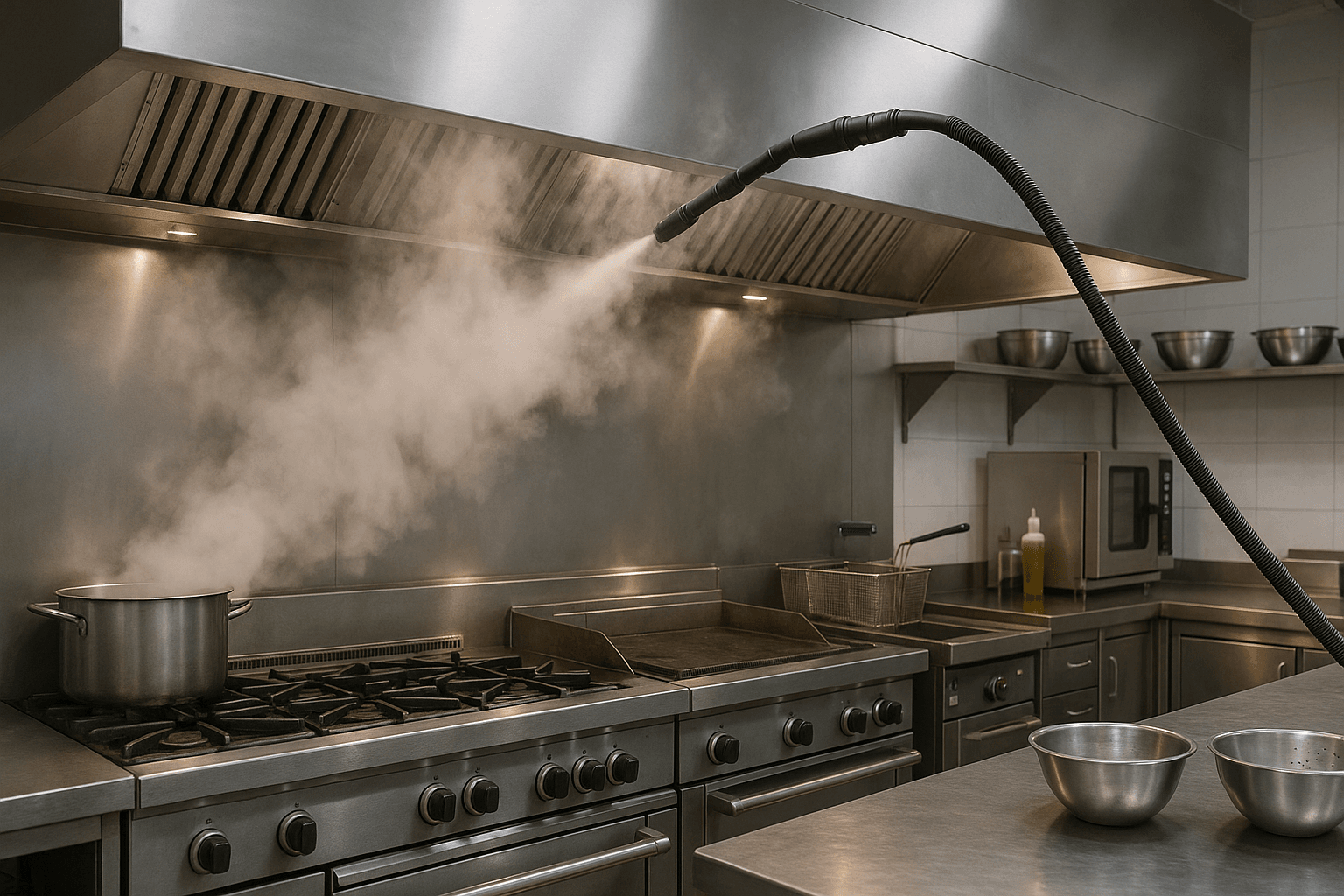
Here’s how a professional crew handles it. We don’t just walk in and start blasting. First, everything gets covered. We wrap the cooking equipment—the fryers, the flat tops, the ranges—in plastic sheeting. We effectively build a funnel or a Containment system to catch the runoff.
The steam melts the grease, which turns into a liquid liquid/water mixture. Gravity does the work, pulling it down into our containment vessels. We aren’t spraying the walls or the floor; the steam is directed precisely into the hood and ductwork. Once the cleaning is done, we remove the plastic, polish the stainless steel to a shine, and mop up any stray droplets.
When you walk in the next morning, the only difference you should notice is that the hood looks shiny and the air feels fresher. No puddles, no mess.
Is It Worth the Cost?
Business owners always have to watch the bottom line. I get it. Margins in the restaurant industry are razor-thin. You might think, “Can’t I just have my dishwasher scrub the visible parts?”
You can, but that’s not cleaning the ductwork or the fan on the roof. And that’s where the danger lies. Professional hood cleaning is an operational expense, yes, but it’s a necessary one. If you skimp on it, you risk fines for non-compliance with NFPA 96, you risk fires, and you risk higher energy bills from inefficient fans.
Think of it like an oil change for your car. You hate paying for it, but you know that if you don’t, the engine blows up. Steam cleaning kitchen hoods is the oil change for your restaurant.
Wrapping It Up
Running a kitchen is hard work. It’s loud, it’s fast, and it’s messy. You focus on the food and the customers; let the pros handle the grease. Switching to a steam-based cleaning method ensures you are getting the deepest clean possible, keeping your staff safe from fire hazards, and keeping the health inspector off your back.
If your hoods are looking a little lackluster, or if you can’t remember the last time someone actually checked the fan on the roof, it might be time to bring in the heavy artillery (the steam, that is).
Don’t wait until you see smoke leaking from the seams of your ductwork. Take a proactive step today to ensure your Salt Lake City kitchen is safe, compliant, and clean. If you’re ready to see the difference steam can make, give us a shout. You can reach us at 801-853-8155 or simply Request a Free Quote right now. Let’s get that kitchen shining.